
Organisation System: Overview
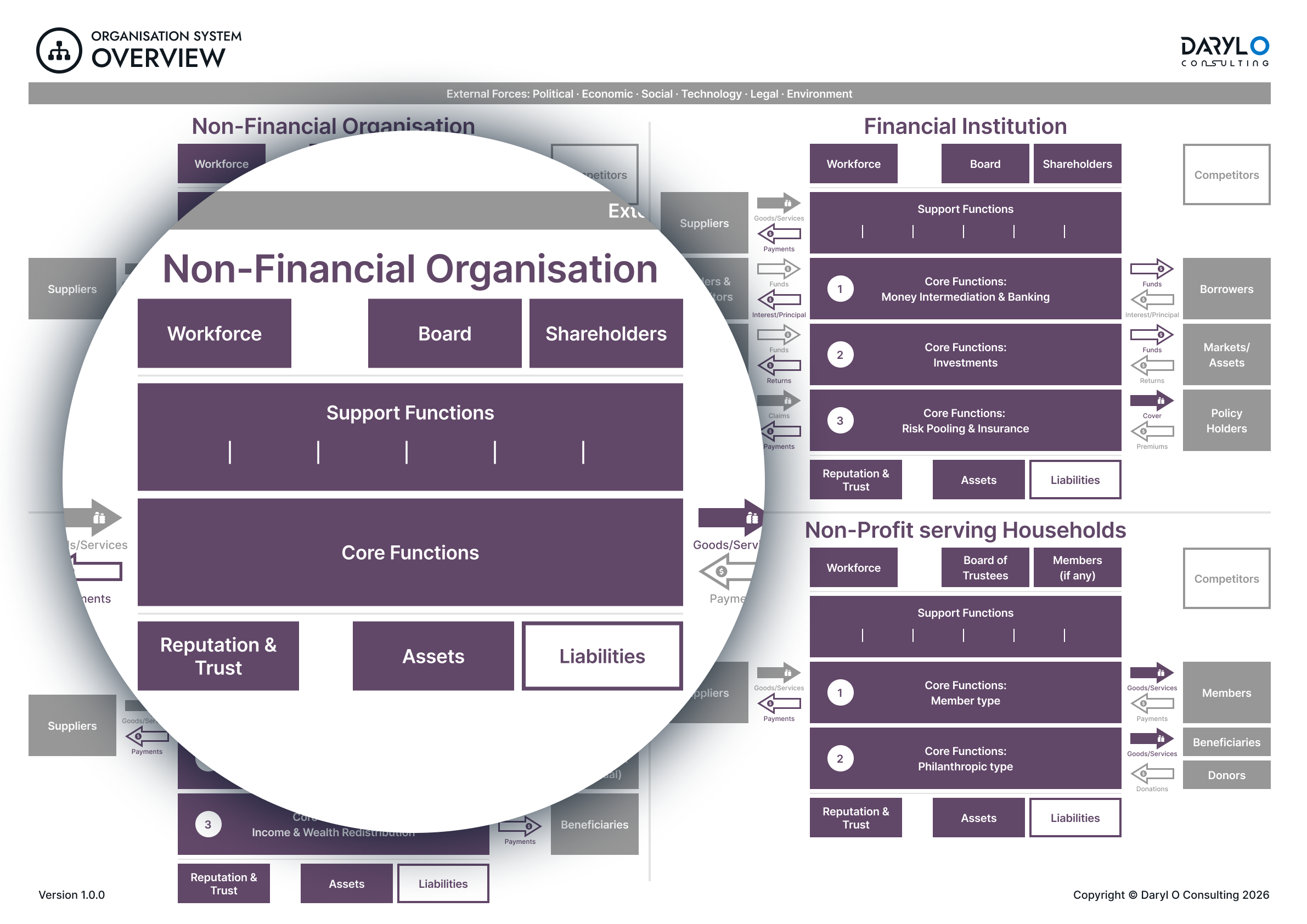
See how any organisation works at a fundamental level, regardless of its type, size, purpose or industry.
The United Nations' System of National Accounts (SNA 2025) identifies two broad groups that make up the economy - Households and Organisations (Legal Entities).
Organisations can then be broken down into four types depending on how they structurally operate, function and are financed:
Non-Financial Organisations (the largest and most common)
Financial Institutions
Government
Non-Profits serving Households
Non-Financial Organisations
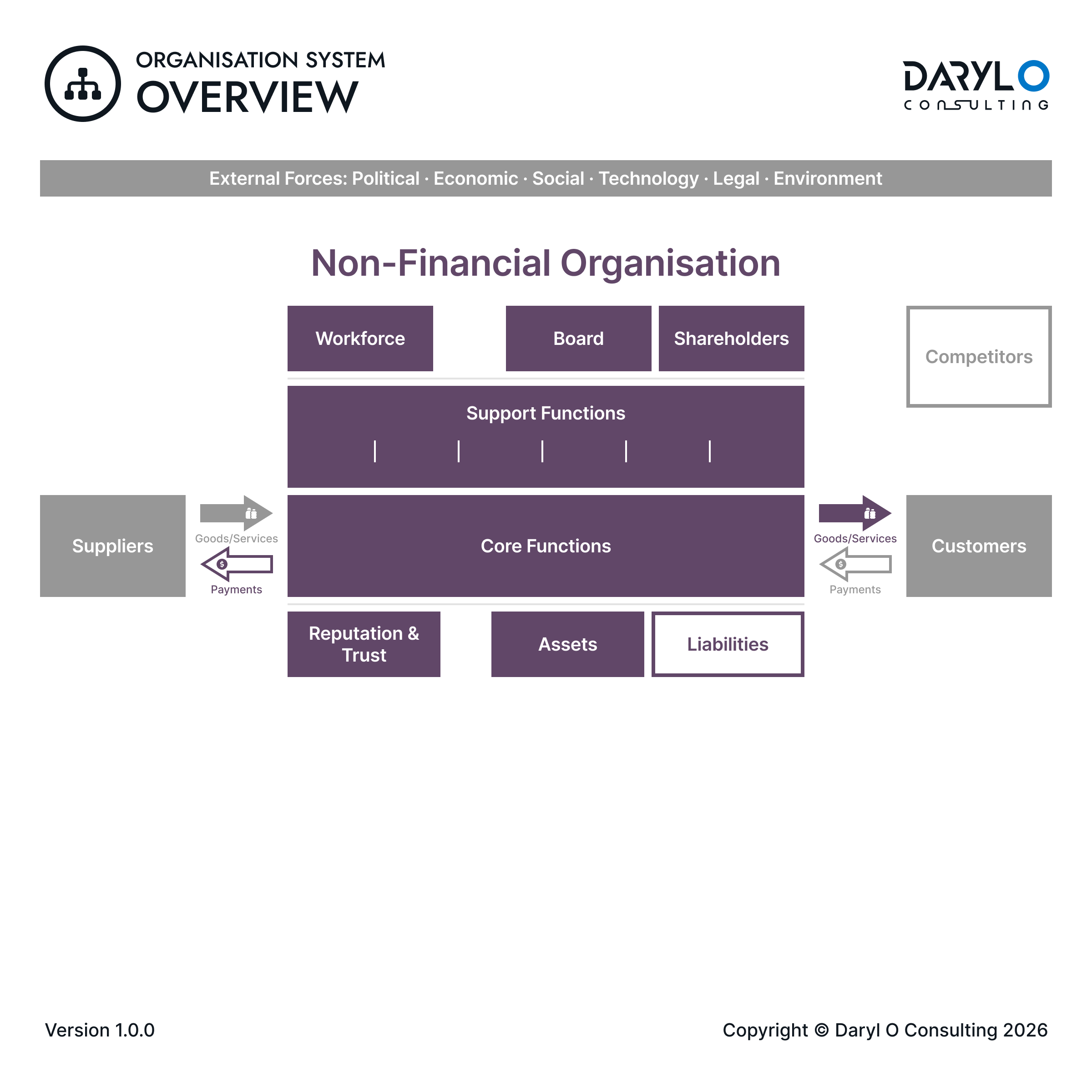
These make up the majority and are responsible for the goods and services we use on a daily basis.
People
The organisation is owned by its shareholders – ranging from a single owner to thousands of investors. Larger organisations separate ownership from management, with a Board (representing shareholders) giving direction, and a Chief Executive Officer leading the Workforce.
Functions
Core Functions are what actually produce goods and services for customers, generating revenue on the right. Costs then flow out to suppliers (as well as their Workforce) on the left.
In addition, those suppliers are also organisations in their own right, each with their own Core Functions. This is what makes this framework ‘chainable’: link organisations together through their Core Functions and you can trace an entire supply chain from raw materials through to final consumption. At a higher level, Core Functions map back to ISIC industries, connecting individual organisations to the broader economy.
Support Functions enable the organisation to operate – Finance, HR, Technology, Legal and others. They are broadly similar across organisation types regardless of what the organisation produces.
Foundations
Assets, Liabilities, and Reputation & Trust are what accumulate over time. Assets are what the organisation owns – equipment, property, cash, intellectual property. It is set against Liabilities, what it owes. The difference between the two is net worth: build assets faster than debt and the base grows.
The simple goal is to sell for more than it costs to produce and deliver. Profits can then be reinvested to build assets and grow future capacity, or returned to shareholders.
Reputation & Trust is harder to count, but no less real – credibility built over time can determine what the organisation can charge, who will partner with them, and what it costs to borrow.
External Forces
Every organisation operates inside forces it cannot fully control. Competition drives innovation and keeps prices in check – (free) markets will self-regulate, unless governments intervene with regulation. Beyond competition, the broader Political, Economic, Social, Technological, Legal and Environmental landscape shapes how organisations operate, what risks they face, and what opportunities they can pursue.
Financial Institutions
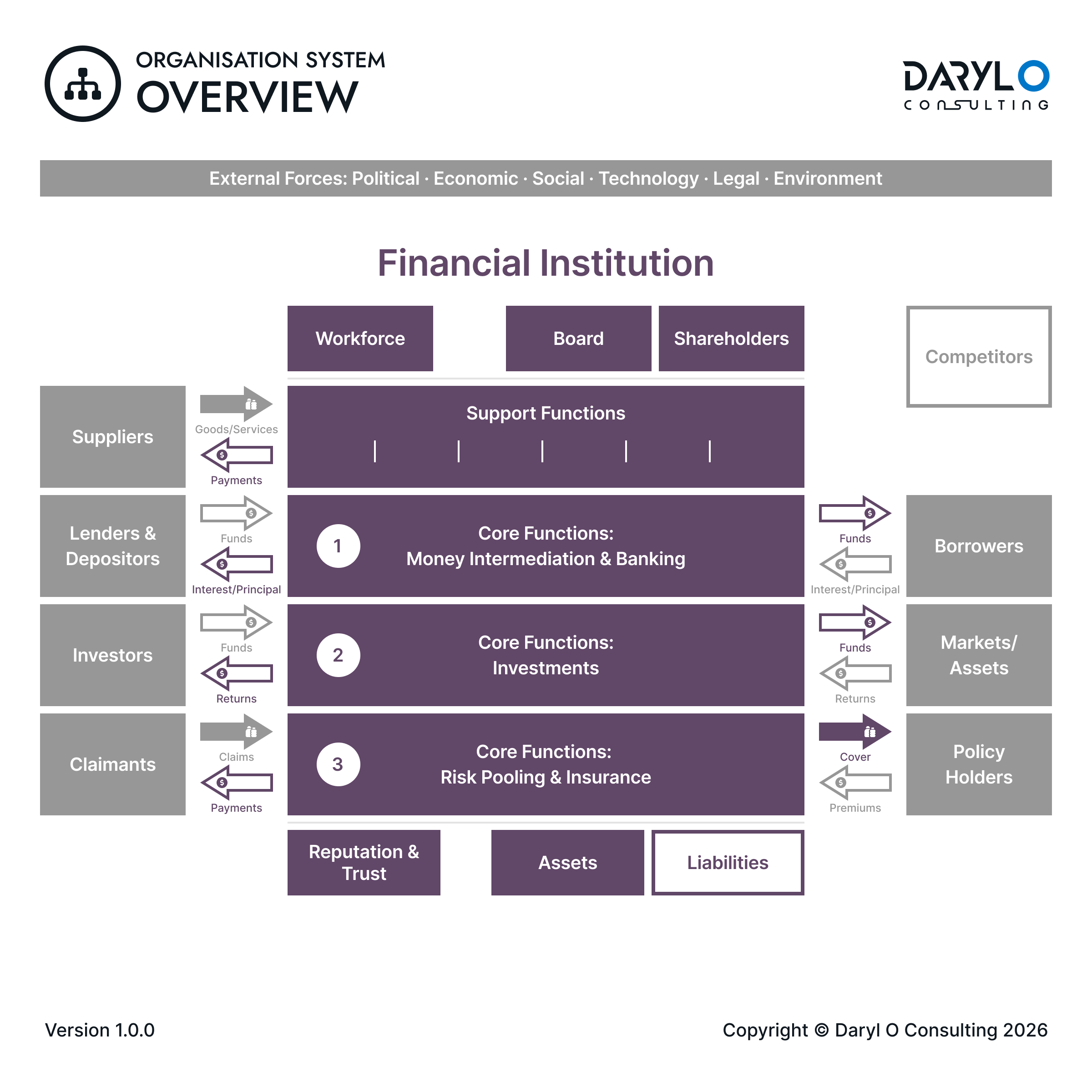
The same structure but the product is financial flows (money), rather than goods or services. Also under heavier regulation due to its critical nature.
Core Functions have three main categories – some institutions participate in one, others in all three.
Money Intermediation & Banking connects Lenders/Depositors and Borrowers. Profit is generated from the spread between the rate paid to lenders/depositors and the rate charged to borrowers, rather than from the sale of goods or services. This also inflates both Assets and Liabilities significantly when compared to a Non-Financial Organisation.
Investments channel capital from Investors into markets and assets to seek a return. Unlike interest, returns are not guaranteed and carry risk – but potentially higher reward. This directs capital into productive economic activity, encouraging organisations to grow and invest in their business.
In Risk Pooling & Insurance, premiums collected from Policyholders fund claims paid to Claimants. The difference generates profit. Insurance plays a crucial role in stabilising economic activity by absorbing the financial impact of unforeseen events.
Government
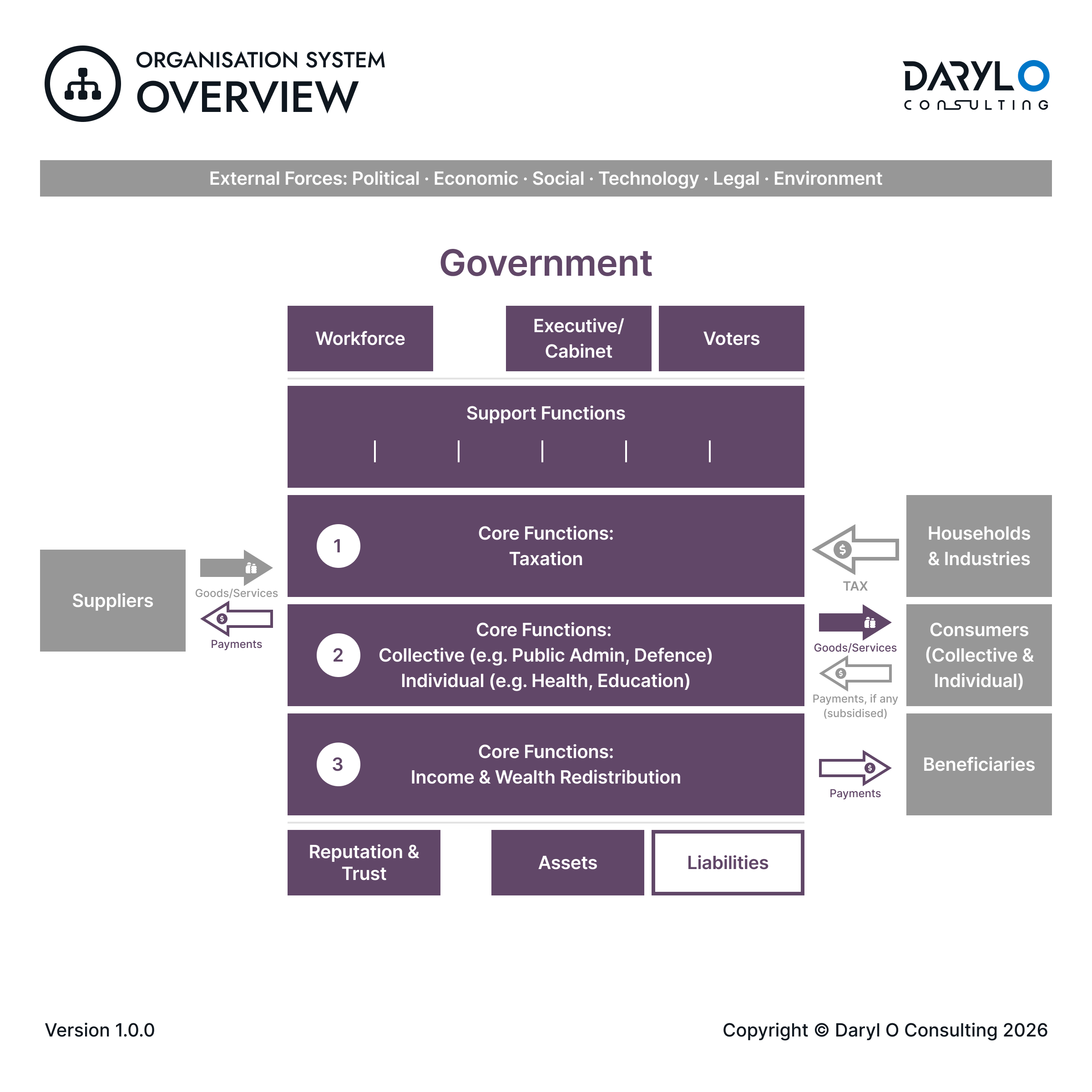
The same framework, but the accountability relationship is fundamentally different. Shareholders are replaced by Voters; the Executive and Cabinet replace the Board.
Revenue is tax – compulsory rather than exchange-based, collected from Households and Industries on the right and pooled together. That funds collective services such as public administration and defence, as well as individual services such as health and education, where an individual benefits (and may require some payment, often subsidised). In addition, government redistributes income and wealth back to some Households directly through payments such as social security.
The right side serves a dual role: the same households and industries that fund government through tax are also the recipients of what it spends. There is no distributable surplus – retained funds either build public assets, reduce sovereign liabilities or accumulate as reserves.
Unlike commercial organisations, government faces no competition in its core functions – which is part of what makes it structurally distinct.
Non-Profit serving Households
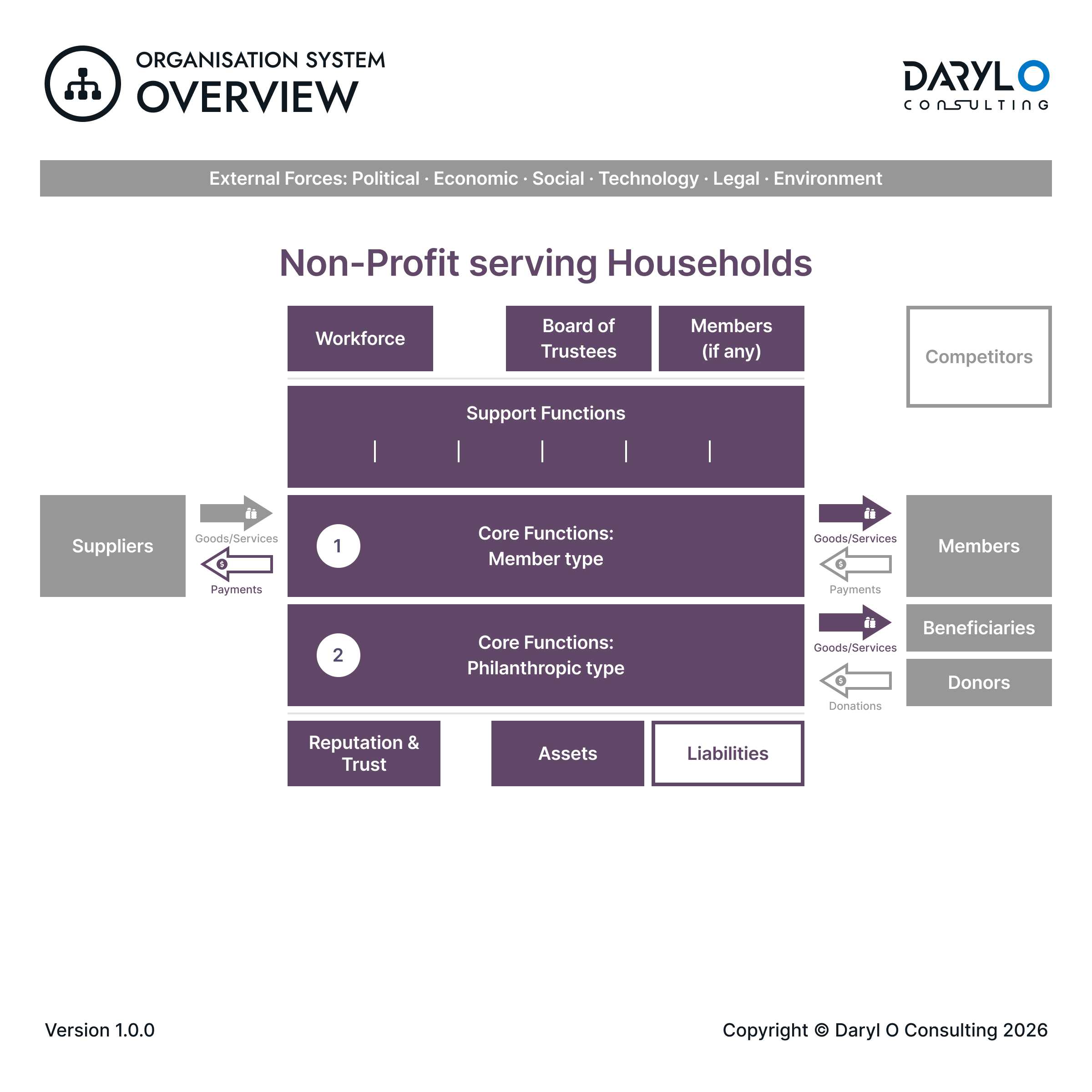
Unlike the other three types, Non-Profits exist to serve a mission rather than generate returns for owners. Any surplus must be reinvested in the mission – it cannot be distributed.
Two sub-types, both built on the same structure.
In the member-serving type, Members fund the organisation and receive its services.
In the philanthropic type, Donors and Beneficiaries are entirely separate parties. Funding flows in from Donors, covers the organisation's costs, and the organisation delivers its services to Beneficiaries. A Board of Trustees replaces the commercial board, with no shareholders – accountability runs to the mission rather than to owners.
See more related content: