
Country System: Overview
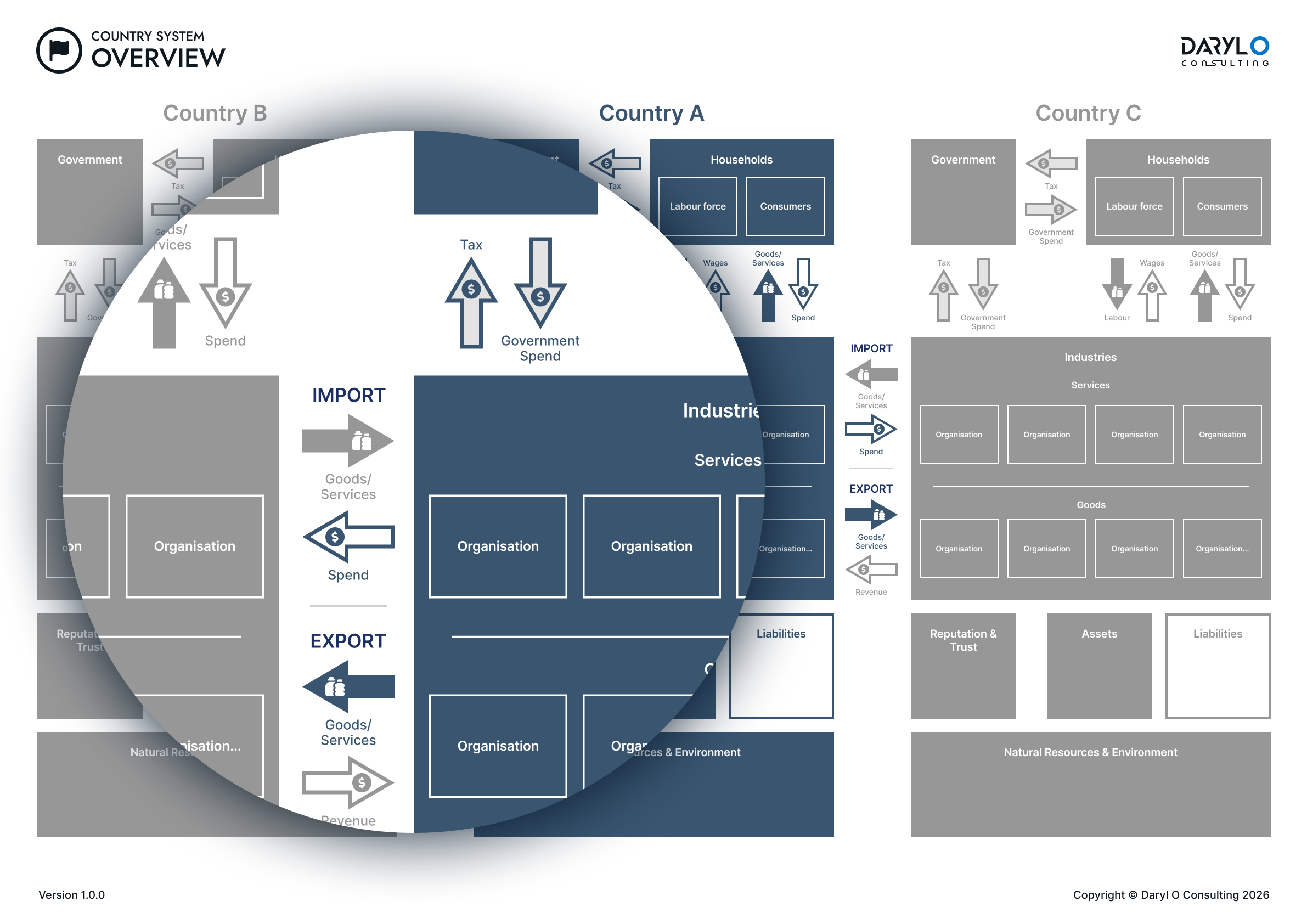
See how a country's economy works as a whole – how government, households and industries connect through the flows of money, goods and labour, and reach across borders through trade.
How to Read
The diagram works in four parts, top to bottom.
1. The core actors – Households, Industries and Government, and the flows between them.
Households supply labour to industries and earn wages, then spend those wages back on goods and services as consumers – the core loop that drives the economy. Industries turn that labour and other inputs into the goods and services everyone else buys. Each industry is made up of individual organisations – the units that actually produce.
The government taxes households and industries and returns it as spending and public services, setting the rules for the whole system.
2. Trade– imports, exports, and trading partners.
No country is a closed system. Supply chains often cross multiple borders – what a country produces may draw on inputs from several others, and what it makes may sell at home, abroad or both. Imports and exports are built into the structure.
Most economics collapses everything foreign into a single figure – "Rest of the World". But countries don't trade with the world. Instead, they trade with specific partners under specific agreements (e.g. Free Trade Agreements). Each partner is a full economy in its own right, with its own households, industries and demand you can actually see and measure.
3. What the country holds– Reputation & Trust, Assets and Liabilities.
While flows sit above, these are the stocks – what a country builds up over time.
Reputation & Trust – a country's standing, built from political stability, economic strength and the quality of what it produces. It's hard to put a number on, so official accounts leave it out – but it's real. Trust lowers the cost of borrowing, attracts investment and talent, and lets exports command a premium. Think of it as the country's brand.
Assets & Liabilities – not all spending is used up. Money spent on roads, infrastructure and capital isn't consumed – it's invested, converted into something that produces value for years. Set against those assets are liabilities – what the country owes, often borrowed to fund investment. The balance between the two is a country's net worth: build assets faster than debt, and the base grows.
4. The foundation – Natural Resources & Environment. The base beneath everything. Every industry ultimately draws on it, and can be depleted or degraded. It underpins the whole system – which is why it sits at the foundation, hence the importance of sustainability.
This has been built on the United Nations' System of National Accounts (SNA 2025), international trade using the IMF's Balance of Payments and International Investment Position Manual (BPM7) and the natural resource using in the System of Environmental-Economic Accounting (SEEA).